
A long day at work, a big storm rolling your way, and my neck has been killing me! What a headache! Today we’re talking about the different types of headaches and how to get them to calm down. As a disclaimer, some headaches are medical emergencies and will not be covered in this article. If you are having a sudden onset headache that feels like you’ve been hit by a bus or if you’re having a headache that comes along with disturbed speech or muscle limpness of the face or body, go to the hospital and get checked out!
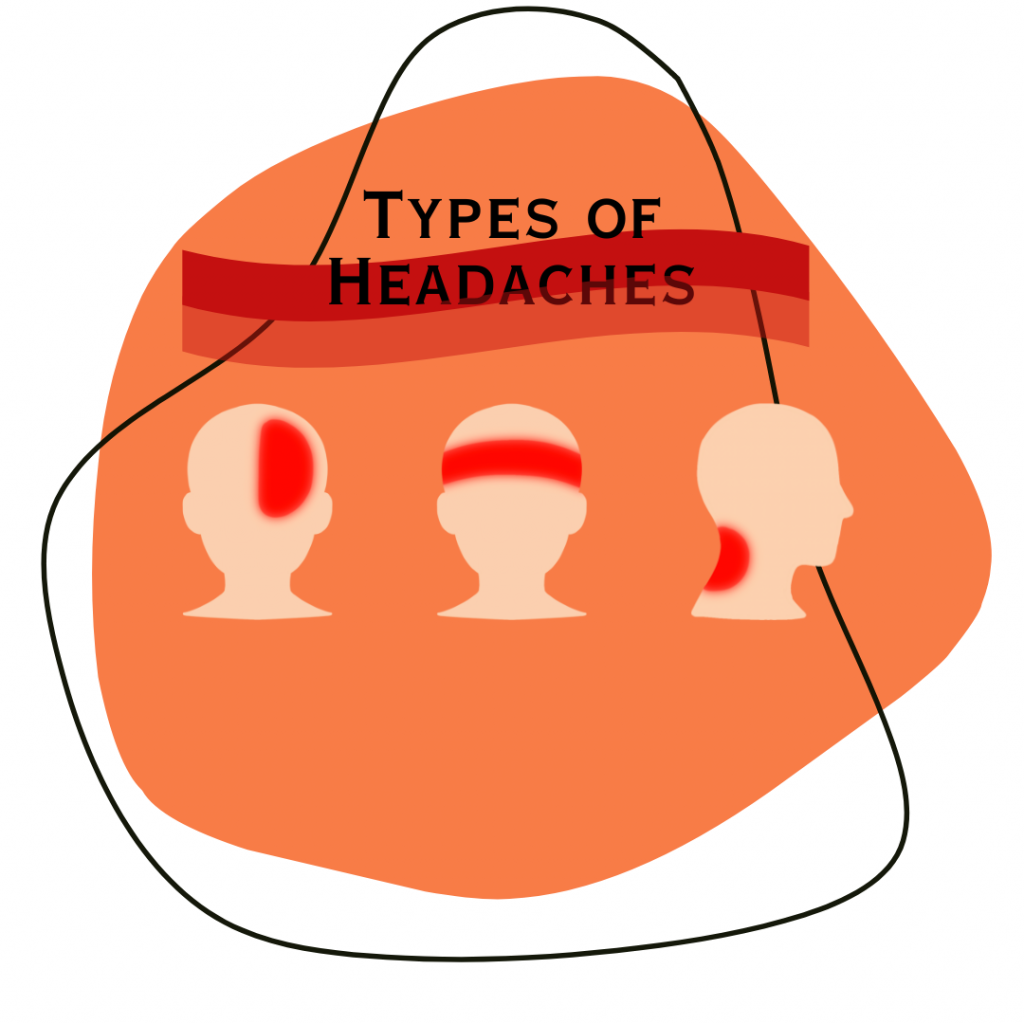
Let’s start with the statistically most common headache type – the tension headache. Tension headaches feel like you have a workout band on your head that’s causing pressure across the forehead and temples on both sides. They often are worse with stress and prolonged screen time but can also be triggered from poor posture and dehydration. One of the best ways to reduce a tension type headache is to practise destressing and taking a break from the screen to get some food and water. These headaches can be repetitive but they are also one of the easiest to get rid of.
Cervicogenic headaches are headaches that originate (genic) from the neck (cervical). These headaches often come with neck pain and can ache from the base of the skull to the shoulders. Often times, there is a vertebrae or muscle (or both) that is a trigger for this headache. An easy test is to feel for any tight muscles in the neck and push on them… if it triggers the headache feeling, it’s probably a cervicogenic headache. Helping patients with cervicogenic headaches is the second most common treatment we do at Westside Chiropractic (besides low back pain)!
The dreaded migraine headache is not so fun for some. There are many cases where people have been suffering from chronic migraines for years. They typically affect one side of the head more than the other and can be brought on by an array of triggers including stress, weather changes, food or alcohol, poor sleep, etc. Migraines don’t only bring a pulsing headache, they like to bring systematic responses like nausea and sensitivity to light or sound as well. Chiropractic treatments have been shown to benefit people who suffer from migraines as well as medications that can be prescribed from your MD. The best way to steer clear of a migraine is to understand what your triggers are and try to avoid them.
Last on the list is cluster headaches. These have been depicted in artwork as a demon that is stabbing the back of your eyeball with a sharp tool. Evidence is still learning why cluster headaches occur and how to treat them, but we know that they’re quite rare. Unfortunately, cluster headaches can be viciously painful with a quick onset. They are known to last about 30 minutes and can affect the eye to cause redness, excess watery eyes, and even a drooping eyelid. Check with your MD if you are affected with cluster headaches and similarly to migraines, see if there are triggers such as foods or medications that cause a headache to flare up.
Happy necks, happy heads,
Dr. Cole Maranger