
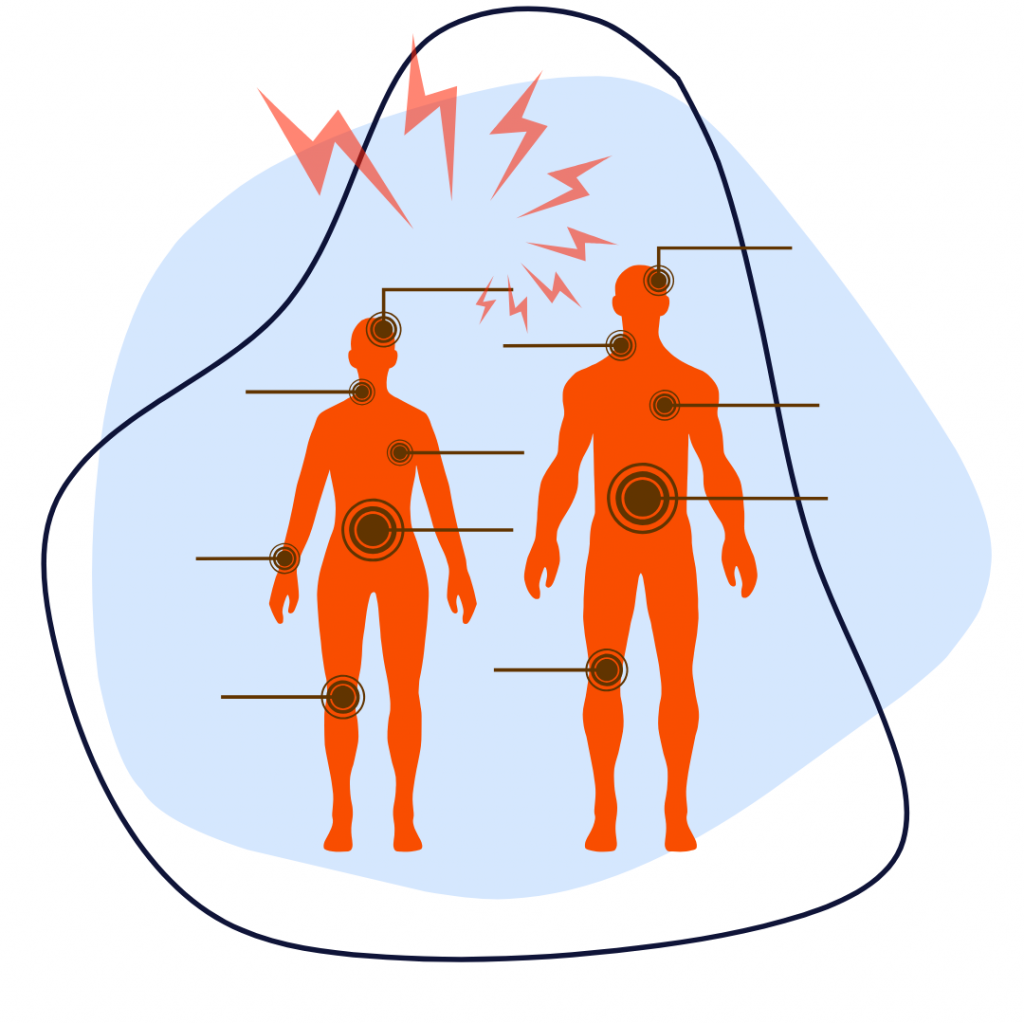
Pain can be a frustrating experience, especially when it’s hard to pinpoint where and why it’s happening. This article is going to give a framework for what bones, muscles, and nerves typically feel like when they are the pain initiators.
Starting with the most common aggravators – the muscles! Muscles can give different sensations depending on what is happening in the muscle itself. A muscle tear will feel different than a stretch or spasm because of how the muscle cells are being damaged.
Muscle tear – muscle tears can give immediate or delayed pain signals to the brain. It can also come with guarded range of motion because your active movement is painful and difficult. Muscle tears can feel really achy and sore along the injury as well as along the referred pain area of that muscle. Sometimes that looks like a shoulder, back, or neck injury producing pain down the arm or low back or hip injury moving down the leg.
Muscle spasm – muscle spasms give extremely reduced range of motion because the muscles themselves feel like a brick. This is almost always because of a bad lift or an injury that the body wants to protect from further damage. It can leave you with sharp pain along the muscle that’s worse with movement.
Sprains and strains are another very common injury we see at the clinic. Also one of the most common workplace injuries with WSIB
Tendon strain – similar to a pulled muscle, a strain on the tendon will have painful active movements and feel sore and achy in the muscle. Depending on the severity of the strain, a muscle can also go into spasm to protect itself from further damage
Ligament sprain – sprains involve the ligament which connects a bone to a bone. This can lead to feeling of instability when using that joint or even hearing a pop or feeling a tear when the injury occurs
Contusion – typically from an impact or a fall, bruises feel bruised and achy. Look for discoloration around the site of injury
Nerve compression – nerves hate being compressed and they tell you that by sending shooting or electric shock-like pains up, down, or across the body. Depending on where the nerve is compressed and where it travels, tells you which nerve is sending the signals.
Most commonly, we see people with leg pain from the sciatic nerve being compressed at the low back and the glutes. This pain can be “sharp” or “shooty” right down to the toes where the nerve ends.
Nerve dissection – this is a very rare injury unless accidentally cut in surgery. When a nerve is dissected, it’s cut or torn and gives no sensation to the skin or no function to a muscle. If a nerve is torn by an injury or cut in surgery, people often report total numbness of the skin or total limpness of a muscle
Joint restriction – this is one of the most common complaints for people seeking chiropractic care. They feel “locked up” or “stuck” in a position or joint. This can also leave the area feeling achy
Joint arthritis – arthritis is found from the bones and joints wearing down over time or with repetitive forces. They often feel achy and stiff with lack of movement. When starting the day, someone with osteoarthritis reports feeling stiff for the first 30 minutes or so after waking up or sitting down for too long until the body “warms up”
Bone bruise – when a big impact hits, but nothing is fractured, you’re often left with a bone contusion which is a bruise under the thin layer that covers the bone called the periosteum. This swelling of the bruise can lead to a feeling of deep aching pain
Bone fracture – fractures are when the bone actually breaks which is severely painful at the time and slowly gets better as it heals. Most often it’s the same feeling as a bone bruise with deep aching bone pain. At night, it can keep people awake because the cellular bone fixers (the osteoblasts that build bone and osteoclasts that clear up bits) are doing their work while you sleep.
I hope this helps you understand how the body feels when an ache or pain hits. If any pain is persistent or severe, have it checked by a healthcare professional to know what the root cause is for treatment.
Happy learning, happy feeling,
Dr. Cole Maranger